
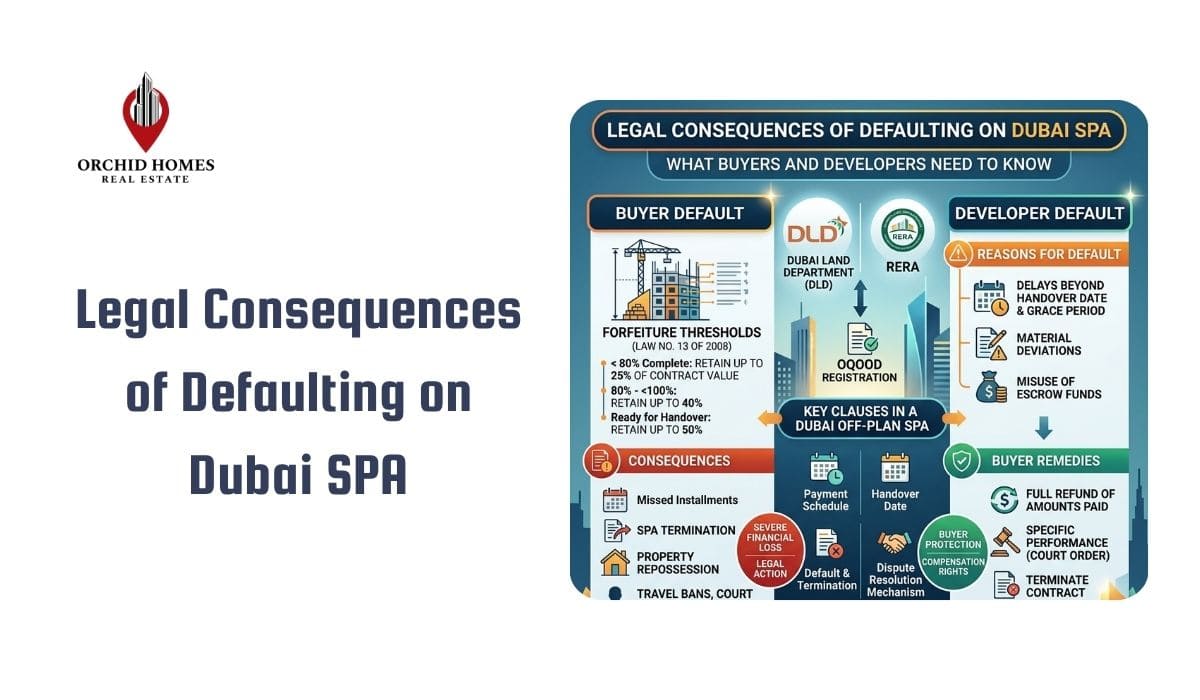
If you have signed a Sale and Purchase Agreement (SPA) for an off-plan property in Dubai, you have entered into one of the most legally significant contracts in the UAE real estate market.
An SPA is not simply a booking form; it is a binding legal document governed by Dubai’s Real Estate Regulatory Agency (RERA) and enforced under Law No. 13 of 2008 on Interim Real Property Registration.
When either party fails to meet its obligations under this agreement, the legal consequences of defaulting on a Dubai SPA can be severe. This may lead to financial forfeiture and property repossession, court judgments, and travel bans.
Whether you are a buyer struggling with installment payments, an investor reconsidering an off-plan commitment, or a developer navigating a non-paying purchaser, this guide breaks down the legal consequences of defaulting on Dubai SPA
What Is a Dubai SPA and Why Does It Matter?
A Sale and Purchase Agreement in Dubai is the formal contract between a property developer and a buyer that governs the purchase of an off-plan or under-construction unit. It specifies the purchase price, payment schedule, handover date, unit specifications, and the rights and obligations of both parties.
Unlike a Memorandum of Understanding (MOU), which is used in secondary market transactions, an SPA is the primary legal instrument for off-plan purchases and carries the full force of Dubai property law.
The Dubai Land Department (DLD) has made it necessary that all SPAs for off-plan properties be registered on the Oqood system. This registration creates a legal record of ownership interest before the title deed is issued. Until a title deed is transferred, the SPA is your legal proof of ownership rights.
Key Clauses in a Dubai Off-Plan SPA
Every Dubai SPA contains several critical clauses that buyers must understand before signing:
- Payment schedule: Defines installment amounts and due dates, often linked to construction milestones.
- Completion and handover date: Sets the developer’s timeline obligation, with grace periods typically ranging from 6 to 12 months beyond the stated date.
- Default and termination clause: Specifies what constitutes a default for both buyer and developer, and the consequences that follow.
- Force majeure provision: Outlines circumstances, such as natural disasters or regulatory changes, under which delays may be excused.
- Dispute resolution mechanism: Directs parties toward RERA, the Real Estate Dispute Settlement Center (RDSC), or Dubai courts.
Understanding these clauses is not optional. They form the legal framework within which any Dubai SPA default penalty is calculated and enforced.
Role of RERA and the DLD in Governing SPAs
RERA, the regulatory arm of the Dubai Land Department, oversees all off-plan real estate transactions in Dubai. It licenses developers, approves projects, monitors escrow accounts, and handles disputes arising from SPA non-compliance. The DLD handles registration and transfers.
Together, these two bodies form the regulatory backbone of Dubai’s off-plan property market, and any sales purchase agreement default in Dubai falls squarely within their jurisdiction.
What Constitutes a Default on a Dubai SPA?
A default occurs when either party materially fails to perform an obligation required by the SPA. The nature and consequences of that default differ depending on whether it is the buyer or the developer who has breached the agreement.
1. Buyer Default: Missed Installments and Payment Obligations
The most common form of buyer default is failure to pay a scheduled installment on time. Under most SPAs, a buyer is given a grace period (typically 30 days) after a missed payment before the developer can take formal action. If payment is not received within that window, the developer may issue a formal written notice of default.
A buyer may also be found in default if they
- Refuse to accept the handover of a completed unit without valid legal grounds
- Fail to pay service charges or other contractual fees, or
- Breach any other material term of the SPA
2. Developer Default: Delays, Quality Failures, and Non-Delivery
A developer defaults when they
- Fail to deliver the property by the agreed handover date (beyond any contractually permitted grace period),
- Deliver a unit that materially deviates from the agreed specifications,
- Misuse of escrow funds, or
- Fail to obtain the necessary No Objection Certificates (NOCs) and completion certificates required for handover.
Dubai property law breach of contract by developers is taken seriously by RERA, particularly given the emirate’s commitment to protecting off-plan buyer rights and maintaining investor confidence.
Partial Payments: How Much Does It Matter?
The amount a buyer has already paid at the time of default is critically important. It directly determines how much the developer is legally entitled to retain under Law No. 13 of 2008.
This is one of the most frequently misunderstood aspects of the Dubai SPA default penalty framework, and getting it wrong can cost buyers hundreds of thousands of AEDs.
Legal Consequences for Buyers Who Default
The legal consequences for a buyer who defaults on a Dubai SPA are structured and proportionate, but they can still be financially devastating if the buyer is unaware of their exposure.
1. Forfeiture of Paid Installments (Law No. 13 Thresholds)
Law No. 13 of 2008 sets clear limits on how much a developer can legally retain from a defaulting buyer’s paid installments, based on the stage of construction at the time of default:
- If construction is less than 80% complete: The developer may retain up to 25% of the total contract value.
- If construction is 80% or more complete: The developer may retain up to 40% of the total contract value.
- If the unit is ready for handover: The developer may retain up to 50% of the total contract value.
Any amount paid by the buyer that exceeds these thresholds must be refunded within one year of the SPA cancellation date, or within six months of the unit being re-sold to a new buyer (whichever comes first). These are mandatory legal protections, not discretionary developer policies, and any SPA clause attempting to waive them is unenforceable under Dubai law.
2. SPA Termination and Property Repossession
Once RERA approves a developer’s cancellation request (following the mandatory 30-day notice period), the SPA is formally terminated. The buyer loses their right to the property, and the developer may repossess the unit and re-list it for sale. The Oqood registration is canceled, and the buyer’s interim ownership interest is extinguished.
This is an irreversible process. Once an SPA is canceled through RERA, reinstating it requires a new agreement with the developer at current market prices. The new agreement may be significantly higher than the original purchase price in a rising market.
3. Travel Bans, Credit Blacklisting, and Court Judgments
The matter may escalate to Dubai courts if the amount owed by the buyer exceeds what can be resolved through SPA termination alone. A court judgment against a buyer can result in:
- A travel ban prevents the buyer from leaving the UAE until the debt is settled.
- Asset freezing orders applied to UAE bank accounts or other local property.
- Credit blacklisting with the Al Etihad Credit Bureau (AECB), affecting future borrowing in the UAE.
- Salary garnishment if the buyer is employed in the UAE.
These are not theoretical risks. Dubai courts routinely enforce such measures in real estate debt cases, and buyers who ignore RERA default notices often find themselves facing these consequences before they have had a chance to respond.
4. Impact on Residency Visa and UAE Golden Visa
For expatriate buyers, the stakes are even higher. A court-issued travel ban can prevent visa renewal, making continued residence in the UAE legally impossible.
For investors who purchased property specifically to qualify for a UAE Golden Visa, an SPA cancellation may invalidate the underlying basis for their visa application. It may also trigger a review of an existing Golden Visa if the property value falls below the required threshold.
Legal Consequences for Developers Who Default
While much attention focuses on buyer defaults, developer defaults on a Dubai SPA carry equally serious consequences. In some cases, there are more severe legal consequences under Dubai property law.
1. RERA-Mandated Refund Obligations
When a developer is found to have defaulted due to unjustified delay, non-delivery, or material breach of specification, RERA may mandate a full refund of all installments paid by the buyer. This refund is disbursed from the project’s escrow account, which developers are legally required to maintain and fund in proportion to construction progress.
Dubai off-plan buyer rights are strongly protected in this regard. The escrow framework was specifically designed to ensure that buyer funds cannot be diverted to other projects or used for non-construction purposes, and RERA audits these accounts regularly.
2. Project Cancellation and Escrow Release Process
If a project is canceled, either at the developer’s initiative or by RERA order, the Dubai Land Department takes control of the escrow account and oversees the distribution of funds to buyers. This process is governed by the RERA Law and the DLD’s Project Cancellation Committee.
Buyers in a canceled project do not need to pursue individual claims; the DLD manages the refund process on a project-wide basis. However, the timeline for refunds can extend over months or years, depending on the number of buyers and the state of the escrow account.
3. Fines, License Suspension, and Criminal Liability
A developer found guilty of material breach (particularly misuse of escrow funds) faces significant regulatory penalties. In such cases, RERA can
- Impose administrative fines,
- Suspend or revoke the developer’s real estate license, and
- Refer cases involving fraud or misappropriation to the Dubai Public Prosecution for criminal investigation.
Penalties under UAE law for real estate fraud can include imprisonment and substantial financial penalties.
How the RERA Dispute Resolution Process Works
Before escalating to courts, most Dubai SPA disputes must first pass through RERA’s dispute resolution framework. Understanding this process helps buyers and developers respond effectively and efficiently.
1. Filing a Complaint with RERA
Either party can file a formal complaint through the Dubai Land Department’s website or customer service centers. The complaint must include the SPA, payment receipts, correspondence records, and a clear statement of the grievance. RERA will review the complaint and may attempt mediation between the parties before making a determination.
2. Real Estate Dispute Settlement Center (RDSC)
If RERA mediation fails, the dispute is referred to the Real Estate Dispute Settlement Center. RDSC is a specialized judicial body established by the Dubai government to handle property disputes quickly and with domain-specific expertise. The RDSC can hear cases, issue binding decisions, and enforce awards in a manner similar to a court. For most SPA disputes, the RDSC is the primary forum before civil court litigation.
3. Escalating to Dubai Courts
If a party is unsatisfied with the RDSC’s decision, they may appeal to the Dubai Court of First Instance, and further to the Court of Appeal and Court of Cassation. Dubai court proceedings are conducted in Arabic, and parties are typically required to engage a UAE-licensed legal representative. Court timelines can range from several months to several years, depending on complexity.
Can a Buyer Negotiate or Exit a Dubai SPA Without Penalty?
Not every SPA that becomes difficult must end in default. There are several legitimate exit mechanisms available to buyers who can no longer meet their obligations.
1. Mutual Rescission Agreements
If both buyer and developer agree to cancel the SPA, they can execute a mutual rescission agreement that sets out the terms of cancellation. This includes what percentage of paid installments is refunded. This is the most flexible option, as the parties can negotiate terms that go beyond (or differ from) the Law No. 13 thresholds. A mutual rescission avoids RERA proceedings, court action, and any risk of adverse legal consequences for the buyer.
2. Novation and Transfer of the SPA to Another Buyer
A buyer may transfer their SPA to a new purchaser through a process known as novation. This requires
- The developer’s written consent
- Payment of applicable DLD transfer fees, and
- Registration of the change on the Oqood system
If the property has appreciated in value since the original purchase, the buyer may be able to sell their SPA position at a profit. This is one of the most effective and underutilized strategies for buyers who no longer wish to complete a purchase but want to avoid forfeiture.
Force Majeure Clauses in SPAs
Some SPAs contain force majeure provisions that excuse non-performance in extraordinary circumstances. These may include a global pandemic, war, or government-ordered lockdown.
Buyers who believe a force majeure event has affected their ability to perform should review their SPA carefully and seek legal advice. The applicability of force majeure clauses in Dubai property disputes is assessed on a case-by-case basis and has been the subject of significant litigation in recent years.
Practical Steps to Take Before Defaulting on a Dubai SPA
If you are at risk of missing a payment or breaching your SPA obligations, acting early is critical. The window between a missed payment and an irreversible legal outcome is narrow.
1. Reviewing Your SPA Default Clauses
Start by reading the default and termination clauses in your SPA carefully. Note the grace period (usually 30 days), the notice requirements, and the forfeiture percentages applicable to your stage of construction. Knowing exactly what the developer is entitled to do gives you a clear picture of your legal exposure and the time you have to act.
2. Negotiating a Payment Extension with the Developer
Many developers in Dubai are willing to negotiate payment extensions, restructured schedules, or temporary deferrals. This is particularly common in a market where reselling a canceled unit at a good price is not guaranteed. Submit a formal written request to the developer as soon as you anticipate difficulty. Developers are far more cooperative before a formal default is triggered than after.
Document all communications in writing. If a verbal agreement is reached, follow it up with a written confirmation email or letter.
When to Engage a UAE Property Lawyer
You should engage a UAE-licensed real estate lawyer if:
- You have received a formal default notice from your developer.
- You believe the developer has breached the SPA, and you wish to claim a refund.
- The developer is refusing to refund amounts above the legally permitted forfeiture thresholds.
- You are considering a novation or mutual rescission and want to ensure the terms are fair.
- You are facing court proceedings or a travel ban related to a property dispute.
Early legal advice is almost always less expensive than reactive litigation. A qualified UAE property lawyer can negotiate on your behalf, file RERA complaints correctly, and represent you before the RDSC or Dubai courts if necessary.
Frequently Asked Questions
What happens if I miss a payment on a Dubai off-plan SPA?
If you miss a payment, the developer must issue a formal written notice giving you 30 days to settle the outstanding amount. If you fail to pay within that period, the developer can apply to RERA to terminate the SPA and, depending on how much you have paid, forfeit a portion or all of your installments under Law No. 13 of 2008.
How much money can a developer keep if a buyer defaults on a Dubai SPA?
Under RERA’s Law No. 13 of 2008, the amount a developer can retain depends on construction progress: if less than 80% complete, up to 25% of the total contract value; if 80% or more complete, up to 40%; and if the unit is ready for handover, up to 50%. Any excess paid beyond these thresholds must be refunded within one year.
Can a developer cancel my Dubai SPA without going to RERA?
No. Under Dubai law, a developer cannot unilaterally cancel an off-plan SPA without first notifying RERA. The developer must demonstrate that the buyer was served a 30-day default notice and failed to comply. RERA then approves the cancellation and oversees any refund due from the escrow account.
What are the legal consequences for a developer who defaults on a Dubai SPA?
If a developer defaults due to project delays, non-delivery, or quality failures, buyers can file a RERA complaint. RERA may order full refunds from the escrow account, impose fines, suspend the developer’s license, or refer the matter for criminal prosecution. Buyers can also file civil claims at the RDSC or Dubai courts.
Can I transfer my Dubai SPA to another buyer to avoid default?
Yes. You may transfer (novate) your SPA to a new buyer with the developer’s written consent and DLD approval. This avoids default consequences and may allow you to recover some or all of your paid installments through the sale price. Novation fees apply and must be paid to the DLD at the time of transfer.
Will defaulting on a Dubai SPA affect my UAE residency visa?
Potentially yes. If a court judgment is issued against you for an unpaid debt arising from a defaulted SPA, it can lead to a travel ban that restricts your ability to enter or exit the UAE and may affect your ability to renew or maintain a UAE residency visa. Consulting a UAE property lawyer early is strongly advised to prevent escalation.
Is there a way to exit a Dubai SPA mutually without financial penalty?
Yes. If both parties agree, a mutual rescission agreement can be signed to cancel the SPA. The terms (including what percentage of paid installments is refunded) are negotiated directly. This avoids RERA proceedings and court action, and is the most amicable resolution when both buyer and developer are willing to settle.
Where do I file a complaint if my developer is not refunding me after SPA cancellation?
File a formal complaint with RERA through the Dubai Land Department portal. If RERA mediation does not resolve the dispute, escalate to the Real Estate Dispute Settlement Center (RDSC) for arbitration, or file a civil claim in Dubai courts. Engaging a UAE-licensed real estate lawyer significantly improves your chances of a favorable outcome.
Conclusion
Defaulting on a Dubai SPA is a serious legal event, but it is rarely a dead end. The regulatory framework established by RERA and Law No. 13 of 2008 provides structured protections for both buyers and developers, with clear rules governing forfeiture, refunds, and dispute resolution.
Whether you are a buyer who has missed payments or a developer dealing with a non-performing purchaser, understanding your legal position early and acting on it promptly is the single most effective way to protect your interests.
The worst outcomes in Dubai SPA disputes almost always arise from inaction: ignored default notices, deferred decisions, and missed negotiation windows. If you are facing a Dubai SPA default situation, the time to act is now.