| The best areas to live in Dubai for expat professionals are Business Bay and Downtown Dubai for finance roles near DIFC, Dubai Marina and JLT for tech and media professionals, and Barsha Heights or JVC for those on a mid-range budget. The right choice depends on your salary bracket, sector, and commute route rather than one-size-fits-all advice. |
Dubai is one of the most popular cities in the world for professional relocation. Around 88.5% of its residents are expatriates, which means the city is built for people who arrive from somewhere else and need to set up a life fast. The challenge is not finding somewhere to live. It is finding the right neighborhood for your specific situation.
Every article you read about the best neighborhoods in Dubai for expat professionals covers the same six or seven areas with the same broad descriptions. What most of them miss is the detail that actually matters to a working professional: how long your commute will take on a Tuesday morning, how much of your salary you will spend on rent, and whether you need a car just to get to a supermarket.
This guide takes a different approach. It maps Dubai’s best areas to live in by professional profile, salary range, and sector. By the end of it, you will know exactly where to start your search.
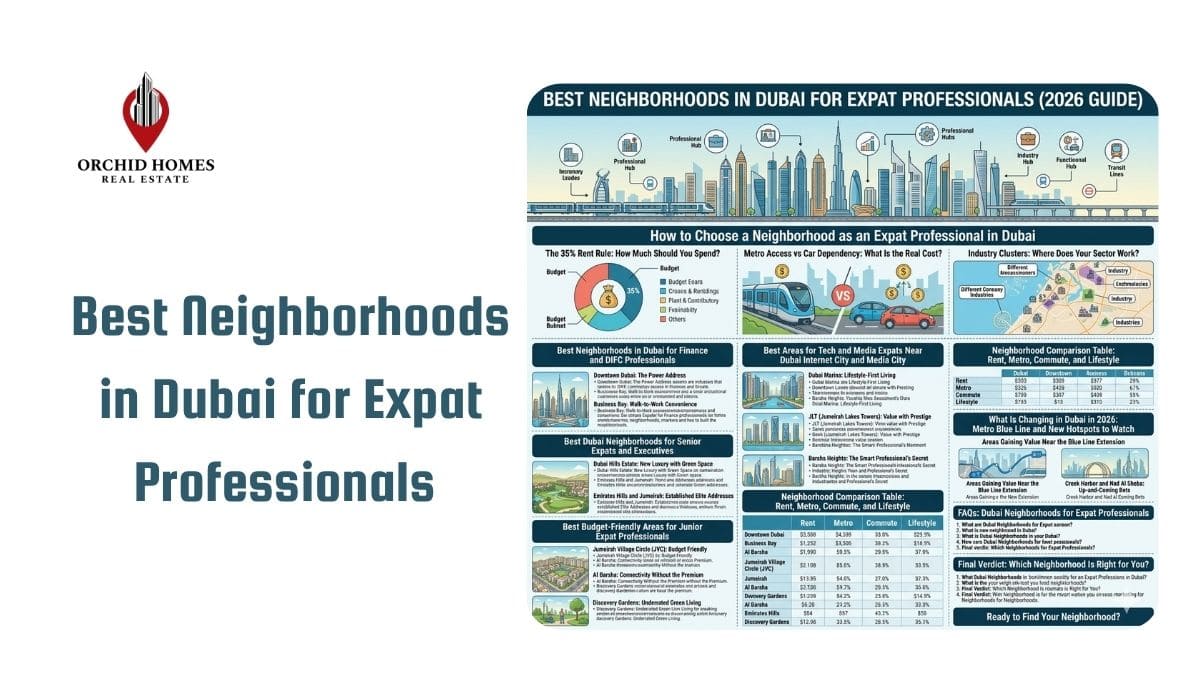
How to Choose a Neighborhood as an Expat Professional in Dubai
Before you look at a single listing, you need to answer three questions. Your answers will cut the list of viable areas in Dubai from dozens to three or four.
1. The 35% Rent Rule: How Much Should You Spend?
Financial advisors consistently recommend spending no more than 30% to 35% of your monthly take-home salary on rent. In Dubai, this rule matters more than in most cities because of the way rent is paid. Most landlords still require rent in one to four post-dated cheques paid upfront. A poor choice of neighborhood can lock you into financial pressure for a full year before you can move.
| Dubai’s residential rental rates rose by 19% in 2024, according to Deloitte’s annual Dubai Real Estate Predictions report. Rental growth has moderated to 4 to 6% year-on-year as of early 2026, but prices remain significantly higher than they were two years ago. Source: Deloitte Middle East, Dubai Real Estate Predictions Report 2025 |
As a practical guide, if you earn AED 15,000 per month, your maximum rent budget is around AED 63,000 per year. That points you toward areas like Barsha Heights, JVC, or Al Barsha. If you earn AED 25,000 to AED 35,000 per month, JLT, Business Bay, and Dubai Marina come into range. At AED 40,000 and above, Downtown Dubai, Dubai Hills Estate, and Emirates Hills become realistic options.
2. Metro Access vs Car Dependency: What Is the Real Cost?
This is where most expat decisions go wrong. People see that a villa in Mirdif or a townhouse in JVC has a lower rent than a tower in JLT, and they stop the calculation there. But life in a car-dependent neighborhood adds a real cost to your monthly budget.
A personal vehicle in Dubai typically costs between AED 2,000 and AED 3,500 per month when you account for car payments, fuel, insurance, Salik tolls, and parking fees. Metro-connected areas charge a rent premium, but they can be cheaper in total monthly outgoings for professionals who do not need a car for their daily commute.
- Metro-connected areas: JLT (DMCC station), Barsha Heights, Business Bay, Downtown Dubai, Dubai Marina (DAMAC Properties station)
- Car-dependent areas: Arabian Ranches, Mirdif, Jumeirah Village Circle, Dubai Hills Estate, Jumeirah
- Rule of thumb: If your office is on the Red Line, live within walking distance of a Red Line station, and skip the car entirely
3. Industry Clusters: Where Does Your Sector Work?
Dubai’s commercial geography is more structured than most cities. Finance professionals cluster in the DIFC and around its adjacent areas. Tech and media companies are concentrated in Dubai Internet City and Dubai Media City, which sit on the western side of the city near the Marina.
Healthcare employers are largely based in Dubai Healthcare City, east of Downtown. This matters because a 20-minute commute in the right direction can easily become 45 minutes of stop-start traffic in the wrong direction during peak hours.
Key Insight: Dubai’s peak traffic hours run from 7:30 to 9:30 AM and 5:30 to 8:00 PM. A journey that takes 18 minutes at midday can take 50 minutes during these windows. Always test your commute at peak hours before signing a lease.
Best Neighborhoods in Dubai for Finance and DIFC Professionals
If you work in banking, investment, consulting, or fintech inside the DIFC, your neighborhood decision is simpler than most. You want to be within a short commute of the Gate Building, and you want to be in a place that matches the professional lifestyle that the DIFC environment tends to create.
1. Downtown Dubai: The Power Address
1BR Rent: AED 90,000 to AED 120,000/year
Downtown Dubai is the address that finance professionals in Dubai tend to gravitate toward once their salaries allow it. It sits within walking distance of DIFC, the Emirates Towers, and Business Bay. Rooftop bars, high-end restaurants, and constant networking events are part of daily life here.
The area is also one of the best-connected on the Red Line, with the Burj Khalifa/Business Bay metro station nearby. The main drawbacks are the tourist density around the Dubai Mall on weekends and the traffic that builds up near the major intersections during peak hours.
Pros
- Walking distance to DIFC
- Metro access
- Best dining and networking scene
- Prestige address
Cons
- High rent
- Weekend tourist congestion
- Limited parking
- Noisy near the main roads
2. Business Bay: Walk-to-Work Convenience
1BR Rent: AED 80,000 to AED 115,000/year
Business Bay is increasingly the residential choice for professionals who work in the area and want to cut their commute to near zero. The neighborhood runs along the Dubai Water Canal and has a mix of residential towers alongside commercial buildings.
It is slightly more affordable than Downtown while offering very similar access to DIFC and the financial district. The canal promenade is one of the better running and cycling routes in the city, which appeals to professionals who want an active lifestyle without driving anywhere to find it.
Pros
- Walk to DIFC
- Canal waterfront
- More affordable than Downtown
- Growing F&B scene
Cons
- Some streets feel corporate
- Construction noise in parts
- Heavy weekday traffic on main roads
Best Areas for Tech and Media Expats Near Dubai Internet City and Media City
Tech, media, and creative professionals working in Dubai Internet City, Dubai Media City, or the surrounding free zones have a very different commute geography from finance professionals. Their offices are clustered on the western edge of the city, which makes Dubai Marina, JLT, and Barsha Heights the logical starting points for the search.
1. Dubai Marina: Lifestyle-First Living
1BR Rent: AED 90,000 to AED 130,000/year
Dubai Marina is the most internationally recognized residential neighborhood in the city. It is a genuine waterfront district with a marina walk, a dense restaurant and bar scene, and some of the best access to JBR Beach in the emirate.
For tech and media professionals, the appeal is clear: Dubai Internet City and Media City are a short Uber ride or a 20-minute walk away, and the DAMAC Properties metro station connects the Marina directly to the Red Line.
The caveat is that landlords in the Marina have increasingly converted units into short-term holiday lets, which has tightened supply and kept rents elevated. It suits professionals with a higher salary and a desire to be at the center of Dubai’s social scene.
Pros
- Waterfront lifestyle
- Strong expat community
- Metro access
- Near Dubai Internet City
Cons
- Highest rents in the west
- Holiday lets reduce long-term supply
- Weekend tourist density
2. JLT (Jumeirah Lakes Towers): Value with Prestige
1BR Rent: AED 65,000 to AED 95,000/year
JLT sits directly across Sheikh Zayed Road from Dubai Marina and offers very similar access to Dubai Internet City and Media City at a noticeably lower price point. It has two metro stations; the DMCC station serves the southern cluster of towers, and the Jumeirah Lakes Towers station covers the northern end.
The community has its own small retail strip along the lake promenades with cafes, restaurants, and supermarkets accessible without a car. JLT also has a notably strong professional networking culture, particularly in the SME, fintech, and consultancy sectors. It is one of the best-value areas in Dubai for a working professional who wants metro access and a decent lifestyle without paying Marina prices.
Pros
- Two metro stations
- Lower rent than Marina
- Lake promenades
- Strong professional community
Cons
- Some older towers
- Less active nightlife than Marina
- Parking can be difficult in busier clusters
3. Barsha Heights: The Smart Professional’s Secret
1BR Rent: AED 65,000 to AED 90,000/year
Barsha Heights, formerly known as TECOM, is consistently underestimated by new arrivals to Dubai. It offers high-rise living comparable to the Marina but at a significantly lower rent, largely because it lacks sea views and the tourist foot traffic.
The Al Barsha metro station is within easy reach, and the area is almost directly across from Dubai Internet City and the free zone cluster. It attracts a large proportion of young professionals who want genuine value for money and are not willing to sacrifice metro access or a reasonable lifestyle to get it.
If you work in the Dubai Internet City or Media City area and earn between AED 12,000 and AED 22,000 per month, this is arguably the single best neighborhood in Dubai for your situation.
Pros
- Best value near Metro
- Close to tech-free zones
- Modern towers
- Less tourist density
Cons
- No sea views
- Fewer premium dining options
- Less social buzz than Marina
Best Dubai Neighborhoods for Senior Expats and Executives
Senior executives and long-term residents in Dubai tend to move away from the high-rise lifestyle as their careers progress. The priorities shift toward space, greenery, school catchment areas, and a quieter residential atmosphere.
1. Dubai Hills Estate: New Luxury with Green Space
3BR Villa Rent: AED 200,000 to AED 300,000/year
Dubai Hills Estate has become one of the most sought-after residential communities in the city for senior professionals and families. It is a master-planned development built around an 18-hole golf course, with parks, cycling paths, and a large mall all within the community.
The area is roughly equidistant from DIFC, Business Bay, and Downtown Dubai, which makes it viable for professionals working across multiple parts of the city. It is car-dependent, so it works best for executives who either have a driver or enjoy driving. The schools in and around Dubai Hills are strong, and the overall quality of the built environment is consistently high.
Pros
- Golf course and parks
- Strong schools nearby
- High build quality
- Good road links
Cons
- Car required
- No metro access
- Premium rents
- Far from the western free zone cluster
Emirates Hills and Jumeirah: Established Elite Addresses
Emirates Hills is Dubai’s equivalent of a gated estate community, with large villas, private gardens, and a quiet residential atmosphere that appeals to the most senior tier of expat professionals. Jumeirah, the beachside villa district along the coast, has been popular with British and European expat families for decades.
Both areas are entirely car-dependent and carry high rental costs. They are best suited to executives on full expatriate packages who will have a driver and whose employer covers a significant portion of housing costs.
Best Budget-Friendly Areas for Junior Expat Professionals
Not every professional arriving in Dubai is on a senior package. Many come as junior or mid-level hires earning between AED 8,000 and AED 15,000 per month. For this group, the choice of neighborhood is not about preference. It is about finding somewhere that leaves enough money at the end of each month to actually enjoy the city.
| AED 7,500 isthe average monthly rent for a one-bedroom apartment in Dubai as of early 2026, according to market data from Bayut and the Dubai Land Department. Budget areas like Al Nahda can be as low as AED 4,200 per month, while prime locations like Palm Jumeirah exceed AED 12,000. Source: Sands of Wealth, Dubai Rental Prices 2026, referencing Bayut and Dubai Land Department data |
1. Jumeirah Village Circle (JVC): Budget Friendly
1BR Rent: AED 55,000 to AED 75,000/year
JVC is now one of the most searched-for residential areas in Dubai among young professionals. It offers modern apartments at rents well below the city average, with a growing selection of cafes, gyms, and supermarkets within the community itself.
The main limitation is that JVC has limited metro access and sits off the main Sheikh Mohammed Bin Zayed Road corridor, which means you will need a car or budget for daily Ubers. For professionals working in Business Bay or DIFC, the commute by car typically runs 20 to 30 minutes in off-peak hours but can stretch beyond 45 minutes at rush hour.
According to Bayut’s Dubai Rental Market Report, mid-tier apartments in JVC saw rental growth of around 4 to 8% during 2025, making it one of the more stable markets in the city.
Pros
- Lowest rents for modern apartments
- Family-friendly feel
- Growing amenities
- Good road links
Cons
- Car or ride-hailing required
- Longer commute to eastern business hubs
- Less social infrastructure
2. Al Barsha: Connectivity Without the Premium
1BR Rent: AED 58,000 to AED 80,000/year
Al Barsha is the area immediately south of Barsha Heights and shares many of its advantages. The Mall of the Emirates and its metro station are nearby, giving residents direct Red Line access.
The area has a large number of international supermarkets, mid-range restaurants, and schools. It is popular with professionals across a wide range of sectors because of its central location and accessibility.
Al Barsha South, a newer extension of the district, has attracted younger residents looking for more affordable options with good road connectivity.
Pros
- Near Mall of the Emirates
- Metro access
- Diverse food options
- Central location
Cons
- Less polished than Barsha Heights
- Some areas feel disjointed
- Road noise near main arterials
3. Discovery Gardens: Underrated Green Living
Discovery Gardens is one of the most affordable large-scale residential communities in Dubai. It sits near Ibn Battuta Mall and the Ibn Battuta metro station, and it offers a genuinely green environment with landscaped paths and relatively quiet streets.
Studios start at around AED 35,000 per year, which makes it accessible even for professionals on entry-level salaries. The commute to Dubai Internet City is manageable, and the metro link keeps things workable for those without a car.
Neighborhood Comparison Table: Rent, Metro, Commute, and Lifestyle
| Neighbourhood | 1BR Rent/Year | Metro Access | Best For | Car Needed? | Lifestyle Score |
| Downtown Dubai | AED 90K–120K | Red Line | DIFC / Finance | Optional | ★★★★★ |
| Business Bay | AED 80K–115K | Red Line | DIFC / Finance | Optional | ★★★★☆ |
| Dubai Marina | AED 90K–130K | Red Line | Tech / Media | Optional | ★★★★★ |
| JLT | AED 65K–95K | Red Line (×2) | Tech / Media / SME | Optional | ★★★★☆ |
| Barsha Heights | AED 65K–90K | Red Line | Tech / Media | Optional | ★★★☆☆ |
| Dubai Hills Estate | AED 200K–300K (villa) | None | Senior Execs / Families | Yes | ★★★★☆ |
| JVC | AED 55K–75K | Limited | Junior Professionals | Yes | ★★★☆☆ |
| Al Barsha | AED 58K–80K | Red Line | All Professionals | Optional | ★★★☆☆ |
| Discovery Gardens | AED 35K–55K | Red Line | Entry-Level | Optional | ★★☆☆☆ |
| Creek Harbour | AED 75K–110K | Blue Line (2029) | Forward-Looking Movers | Currently yes | ★★★★☆ |
What Is Changing in Dubai in 2026: Metro Blue Line and New Hotspots to Watch
If you are making a relocation decision for two to three years rather than just the next twelve months, the Dubai Metro Blue Line is the single most important piece of infrastructure news in the city right now.
| 25% is the projected increase in property prices and rents in neighborhoods along the Dubai Metro Blue Line route, according to the RTA and corroborated by industry analysts. The Blue Line spans 30 kilometers with 14 new stations and is scheduled to open in September 2029. Source: RTA Dubai, reported by Bayut and The National, June 2025 |
Construction officially began in 2025, and the Blue Line will connect areas that have never had metro access before. It runs from Dubai Creek Harbor in the west through Ras Al Khor, International City, Dubai Silicon Oasis, and Academic City before linking back to the existing network. The RTA has projected that property prices and rents near Blue Line stations will rise by up to 25% as the line nears completion.
Areas Gaining Value Near the Blue Line Extension
The historical pattern in Dubai is clear. When the Red Line opened and improved connectivity to Dubai Marina and JLT in 2009, long-term value in those areas grew meaningfully over the following years. The Blue Line is expected to produce the same effect in the east of the city.
- Dubai Silicon Oasis: A growing tech hub that will gain its first metro connection. Rents are currently low, and proximity to Academic City and tech employers makes it appealing for digital sector professionals.
- International City: Currently one of the most affordable residential areas in Dubai. The underground interchange station will dramatically change its accessibility.
- Ras Al Khor: A less obvious pick, but its position between Creek Harbor and International City along the Blue Line gives it upside potential
Creek Harbor and Nad Al Sheba: Up-and-Coming Bets
1BR Rent: AED 75,000 to AED 110,000/year
Creek Harbor is an Emaar-developed waterfront community east of Downtown Dubai. It is currently car-dependent, but the upcoming Blue Line Emaar Properties Station will be built here. The station is designed by Skidmore, Owings and Merrill, the same firm behind the Burj Khalifa, and will be 74 meters tall, making it the world’s tallest metro station.
Rents are currently below comparable waterfront areas like the Marina, and the community has a high-quality built environment with strong green spaces and canal views. For professionals willing to use a car or Uber for two to three years, Creek Harbor offers some of the best medium-term value available in Dubai right now.
Pros
Below-market rents vs comparable waterfront
- Emaar quality
- Blue Line incoming
- Strong appreciation potential
Cons
- Currently car-dependent
- Fewer local amenities than in established areas
- Further from DIFC
Nad Al Sheba is a quieter option for professionals who work in Business Bay or DIFC and want more space at a lower price point. It sits between the city’s financial district and the Meydan racecourse, and recent road improvements have made it more commutable than it was three years ago.
FAQs: Dubai Neighborhoods for Expat Professionals
What is the best neighborhood in Dubai for expat professionals?
The best neighborhood depends on your sector and salary. Business Bay and Downtown Dubai are top choices for finance professionals working near DIFC, with 1-bedroom apartments ranging from AED 80,000 to AED 120,000 per year. Dubai Marina and JLT suit tech and media professionals near Dubai Internet City, offering rents of AED 65,000 to AED 130,000. For budget-conscious professionals, Barsha Heights and JVC offer metro access and modern apartments for AED 55,000 to AED 90,000 per year.
How much should an expat professional budget for rent in Dubai in 2026?
Financial advisors recommend spending no more than 30 to 35% of your monthly salary on rent. Following a 19% rental spike in 2024, the average 1-bedroom apartment in Dubai costs around AED 7,500 per month as of early 2026. Professionals earning AED 15,000 per month should target areas like Barsha Heights or JVC to stay within the 35% rule. Rent growth has moderated to 4 to 6% year-on-year in 2026, which is more manageable than the double-digit increases of 2023 and 2024.
Which Dubai neighborhoods are closest to DIFC and Business Bay?
The closest residential areas to DIFC and Business Bay are Downtown Dubai (walking distance), Business Bay itself (many residential towers within the district), and Za’abeel, which is 5 to 10 minutes by car. Dubai Marina and JLT are approximately 20 to 30 minutes by Metro during off-peak hours, but can exceed 45 minutes by car during peak traffic between 7:30 and 9:30 AM.
Is it better to live near the Dubai Metro as a working professional?
Yes, for most professionals. Living near a Dubai Metro station can save AED 2,000 to AED 3,500 per month in car ownership costs. Metro-connected areas like JLT (DMCC station), Barsha Heights, and Business Bay offer faster and more predictable commutes. However, metro coverage is still limited. Car-dependent areas like Arabian Ranches have lower headline rents but require a personal vehicle, which often offsets the savings entirely when you factor in all running costs.
What are the most affordable neighborhoods in Dubai for young expat professionals?
The most affordable areas for young professionals in Dubai in 2026 are: JVC with 1BR from AED 55,000 per year, Barsha Heights from AED 65,000, Al Barsha from AED 58,000, Discovery Gardens with studios from AED 35,000, and Al Nahda from AED 25,000 for a studio, though the last option involves a longer commute. JVC and Barsha Heights offer the best balance of affordability and access for working professionals.
Do expat professionals in Dubai need a car, or is public transport sufficient?
It depends on your neighborhood and work location. Expats in JLT, Barsha Heights, Business Bay, or Downtown Dubai can rely primarily on the Dubai Metro and ride-hailing apps. Professionals in Arabian Ranches, Mirdif, Dubai Hills Estate, or JVC will need a personal vehicle for daily commuting. The Dubai Metro Red Line runs along Sheikh Zayed Road and connects most of the city’s key professional districts, but the network still has significant gaps in coverage, particularly in newer suburban communities.
Which neighborhood is best for networking and professional events?
DIFC and Downtown Dubai host the highest concentration of international firms, professional dinners, and industry events in the city. Business Bay has a growing events calendar with co-working spaces and rooftop venues. JLT has a strong SME and startup community and is a good base for entrepreneurs and early-stage tech professionals who rely on community networking as part of their working life.
Are there up-and-coming Dubai neighborhoods worth considering for expat professionals in 2026?
Yes. Three areas stand out. Creek Harbor is a high-quality waterfront community with rents still below comparable areas and a Blue Line metro station incoming. Dubai Silicon Oasis will gain metro access through the Blue Line by 2029 and suits tech professionals at more affordable rents. Nad Al Sheba is a quieter, more connected option for professionals who want space without paying Dubai Hills Estate prices. All three are worth watching as medium-term relocation decisions.
Final Verdict: Which Neighborhood Is Right for You?
The best areas to live in Dubai for expat professionals are not determined by rankings. They are determined by your salary, your sector, and how you want to spend the hours outside your working day. The table below gives you a fast decision framework before you start looking at listings.
| Profile | Recommended Areas | Why It Fits |
| Finance Pro / DIFC | Business Bay or Downtown | Walk to work, Metro access, strong professional scene |
| Tech / Media Pro | JLT or Barsha Heights | Best value-to-commute ratio for the western free zones |
| High Earner / Executive | Dubai Hills or Jumeirah | Space, greenery, school access, prestige address |
| Junior Professional | JVC or Al Barsha | Affordable rents, modern apartments, a growth community |
| 2-Year Strategic Mover | Creek Harbour | Below-market rents, Blue Line incoming, Emaar quality |
| Entry-Level Budget | Discovery Gardens | Metro-connected, green, most affordable for a working life |
One final point worth making: do not make your decision from a laptop before you land. Dubai is a city where the feel of a neighborhood matters as much as the data behind it. Take a week in a serviced apartment, visit your shortlisted areas at 8 AM on a weekday and again on a Friday evening, and talk to people who already live there. The right neighborhood will become obvious quickly once you are on the ground.
| Ready to Find Your Neighborhood? Book a free consultation with our Dubai real estate specialists. We will match you to the right area based on your salary, sector, and lifestyle before you sign a single lease. |