| Choosing between a serviced apartment vs hotel in Dubai depends on your stay length and budget. Hotels win for short trips of 1 to 4 nights. Serviced apartments win for stays of 7 nights or more. They cost 15% to 30% less, offer kitchens, laundry, and up to 50% more space. |
Dubai attracts over 17 million visitors each year. Picking the right accommodation is one of the biggest decisions you will make. The serviced apartment vs hotel in Dubai pros cons debate is real, and the answer is not always obvious.
This guide breaks down every factor. It covers cost, space, fees, legal rules, and traveler types. By the end, you will know exactly which option suits your trip.
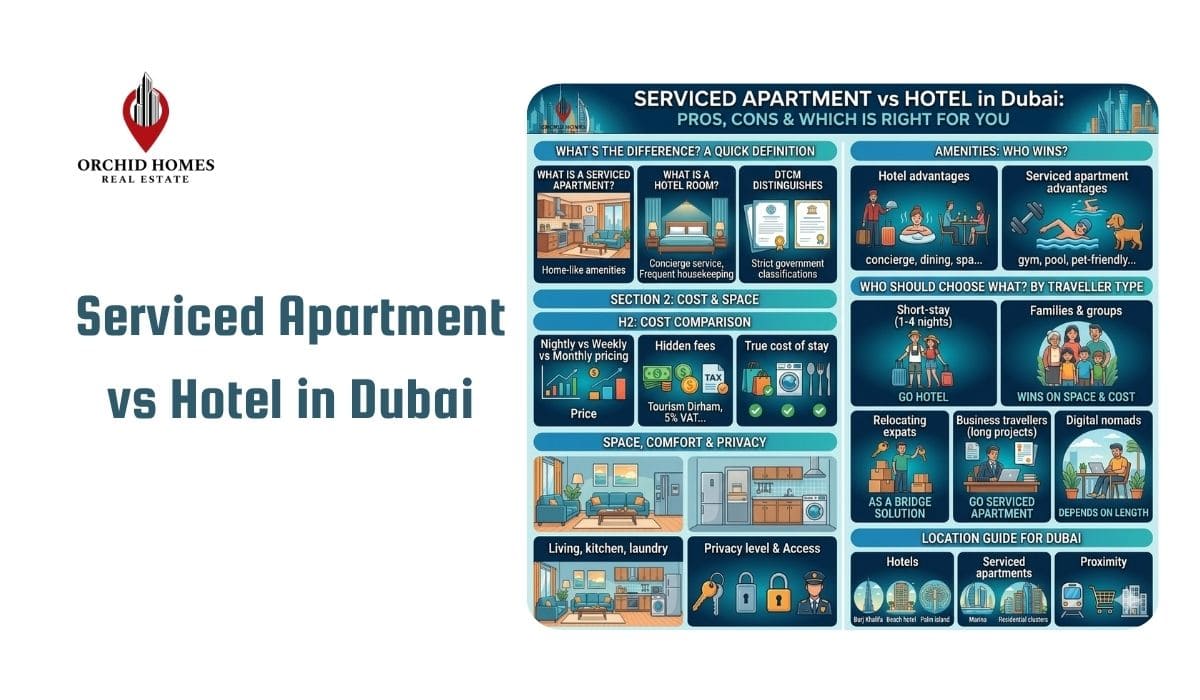
What Is the Difference? A Quick Definition
What is a Serviced Apartment in Dubai?
A serviced apartment Dubai long stay unit is a fully furnished residential apartment, and it combines hotel services with the space and feel of a real home. You get a separate bedroom, a living area, and a fully equipped kitchen, while most units also include a washing machine, dishwasher, and private balcony.
DTCM licensed apartments in Dubai are regulated by the Dubai Department of Economy and Tourism, and they operate under a hotel establishment license, which means they meet strict safety and quality standards. Housekeeping is typically provided weekly or bi-weekly, although daily service is available at an extra cost.
What is a Hotel Room and Hotel Apartment in Dubai?
A standard hotel room is a single furnished bedroom within a managed hotel property, and a hotel apartment Dubai vs hotel room comparison reveals key differences.
Hotel rooms include daily housekeeping, 24-hour concierge, on-site dining, and room service, while hotel apartments sit inside branded properties like Marriott Executive Apartments or Rotana. They offer more space than a standard room but operate fully under a hotel license, and hotel apartments charge the same layered fees as hotels, with more on those fees explained below.
How Dubai’s DTCM Licensing Distinguishes Them
This is where most guides get things wrong, because Dubai has three distinct categories.
- First are licensed hotel apartments under a full hotel brand,
- Second are independently licensed serviced apartments, and
- Third are holiday homes registered under a separate DTCM holiday home framework.
Holiday homes in Dubai are not the same as serviced apartments, as they fall under different regulations entirely. Serviced apartments are hotel establishments, so they do not issue Ejari contracts, while Ejari is a formal tenancy registration used for visas and Emirates ID applications. If you need Ejari for documentation purposes, you must sign a standard 12-month residential lease.
Cost Comparison: The Real Price Breakdown
1. Nightly, Weekly, and Monthly Pricing
For a 1-bedroom unit in Business Bay, a mid-range hotel charges around AED 650 per night, while a comparable serviced apartment costs around AED 400 to 480 per night.
At 30 nights, the hotel costs roughly AED 19,500. Whereas the serviced apartment costs roughly AED 12,000, which is a saving of over AED 7,000 on the base rate alone, and that is before adding meals and laundry.
Serviced apartments are usually cheaper than hotels in Dubai for stays of 7 nights or more. For stays under 5 nights, nightly rates are often similar, and the real gap opens at the 7-night mark.
2. Hidden Fees: Tourism Dirham, 5% VAT, and Municipality Charges
Dubai hotels legally charge four separate government fees on top of the base room rate.
| Fee Type | Hotels | Serviced Apartments |
| Tourism Dirham | AED 7 to 20 per night (by star rating) | AED 7 to 20 per night (capped at 30 nights) |
| Municipality Fee | 10% of the room rate | Usually not applied |
| Service Charge | 10% of the room rate | Not applicable |
| VAT | 5% | 5% |
| Total Tax Load | ~25 to 30% on top of base rate | 5 to 10% typically |
On a hotel room priced at AED 600 per night, you can expect to pay AED 750 to 780 after all fees. Therefore, a 10-night stay at AED 600 base becomes AED 7,500 to 7,800 in real cost.
Serviced apartments bundle Wi-Fi, utilities, and sometimes parking into the monthly rate, and you should always confirm if 5% VAT is included in your quoted rate before booking.
The Tourism Dirham fee Dubai is capped at 30 consecutive nights for serviced apartments, whereas hotels charge it indefinitely.
3. True Cost of Stay: Savings on Dining, Laundry, and Utilities
A Dubai furnished apartment for short-term comes with a full kitchen, and this changes the economics completely. Eating out for three meals in Dubai costs AED 150 to 250 per person per day, but cooking at home cuts that figure by 60% to 70% easily.
Over 14 days, a family of three saves AED 2,500 to 4,000 on food alone, while in-unit laundry eliminates dry-cleaning costs, since hotels charge AED 20 to 50 per garment. Utilities and Wi-Fi in serviced apartments are usually bundled, whereas hotels bill these separately.
Space, Comfort, and Privacy
1. Living Area, Kitchen Facilities, and Laundry
A standard hotel room in Dubai is 25 to 35 square meters, while a 1-bedroom serviced apartment averages 55 to 80 square meters, which is 50% to 100% more space at a comparable or lower price point.
Serviced apartments come with a fully equipped kitchen that includes a fridge, oven, microwave, and utensils. Whereas hotel rooms may offer a minibar or kettle, and some budget hotels include a kitchenette, but this is rare.
In-unit washing machines are standard in serviced apartments, while hotels offer laundry services at premium rates.
2. Privacy Levels and Building Access
Hotels have shared corridors, lobby foot traffic, and daily room entry by housekeeping staff, whereas serviced apartments offer separate entrances and far lower shared foot traffic.
There are no busy corridors or multiple strangers passing your door each day, and this makes serviced apartments ideal for families, long-stay workers, and guests who value personal space.
3. Housekeeping Frequency Differences
Hotels provide daily housekeeping as standard, which means daily entry into your room, whereas serviced apartments typically clean weekly or bi-weekly, giving you more control over your space.
Daily housekeeping is available in most serviced apartments on request, but it carries an additional charge, and for long stays of a month or more, weekly cleaning feels more natural and less intrusive.
Amenities and Services: Who Wins?
1. Hotel Advantages: Concierge, Dining, Spa, and Loyalty Points
Hotels genuinely excel in service infrastructure, and this is where they justify their higher cost. A 24-hour concierge can book restaurants, arrange airport transfers, and handle last-minute requests. While on-site restaurants, breakfast buffets, and room service are hotel-exclusive benefits.
Luxury spas, fitness centers, and rooftop pools are common in 4-star and 5-star properties, and business travelers accumulate loyalty points through Marriott Bonvoy, IHG Rewards, and Hilton Honors. These points translate to free nights, upgrades, and airport lounge access across global properties, while executive lounge access at top hotels also provides a genuine networking environment.
High-profile hotel stays in Dubai can put you in the same room as executives and investors, and for short-stay corporate guests, this social and professional value is difficult to replicate.
2. Serviced Apartment Advantages: Gym, Pool, and Pet-Friendly Policies
Most quality serviced apartment buildings include a gym, swimming pool, and recreational spaces. These amenities are typically included in the rental rate, so no daily fee is charged separately.
Dubai accommodation for families often favors serviced apartments for the additional kitchen and living space. Many serviced apartment buildings in Dubai are pet-friendly, which is very rare in hotels. Some properties also offer parking, meeting rooms, and a rooftop terrace at no extra cost.
3. Business Facilities: Meeting Rooms vs Hotel Business Centers
Hotel apartment Dubai business traveler options include dedicated business centers with printing, scanning, and high-speed Wi-Fi. Hotels often provide conference rooms bookable by the hour, which suits short corporate visits.
Serviced apartments increasingly offer co-working spaces and bookable meeting rooms on site. For long-stay corporate guests, the ability to host in-apartment meetings is a genuine advantage. The apartment environment is also quieter and more private for video calls and focused work.
Location Guide for Dubai
1. Hotels: Downtown Dubai, JBR, and Palm Jumeirah
Dubai’s top hotels cluster around its most iconic addresses, as Downtown Dubai hosts the Burj Khalifa, Dubai Mall, and some of the city’s best 5-star properties.
JBR (Jumeirah Beach Residence) offers beachfront hotels with direct beach and marina access, while Palm Jumeirah is home to ultra-luxury properties, including Atlantis and Waldorf Astoria.
These locations are excellent for short tourist stays, although they carry premium room rates to match.
2. Serviced Apartments: Business Bay, Dubai Marina, JVC, and Al Barsha
Dubai Marina serviced apartments offer waterfront living with metro access and a walkable neighborhood. Business Bay hotel apartments provide corporate proximity to DIFC, Downtown, and Sheikh Zayed Road.
Jumeirah Village Circle (JVC) is popular for families because it offers larger units at lower price points, and Al Barsha is central, near Mall of the Emirates, and well-connected to major business hubs. International City and Deira offer budget-friendly options for mid-range and long-stay travelers.
3. Proximity to Metro, Malls, and Business Hubs
Dubai Marina, JLT, and Business Bay all sit on the Dubai Metro red line, so choosing a serviced apartment near a metro station eliminates the need for a daily rental car. A rental car in Dubai costs around AED 2,500 to 3,500 per month for a standard vehicle, while metro-connected areas like Sheikh Zayed Road and JLT are especially cost-effective for long stays.
Who Should Choose What? By Traveler Type
1. Short-Stay Tourists (1 to 4 Nights): Choose a Hotel
If you are visiting Dubai for a long weekend or a short break, a hotel is the smarter choice because you want concierge service, a pool, easy access to tourist attractions, and zero setup.
Hotel rates on short stays are competitive, and the convenience factor is genuinely worth the cost, since you will not use a full kitchen or in-unit laundry on a 3-night stay.
2. Business Travelers on Long Projects: Choose a Serviced Apartment
If you are working in Dubai for 4 weeks or more, a serviced apartment Dubai long stay is the better professional option. You can maintain a routine, cook your own meals, and work in a quiet private environment.
The financial savings over a month are significant, and they can exceed AED 8,000 compared to a hotel, which is why many corporate housing packages in Dubai now default to serviced apartments.
3. Families and Groups: Serviced Apartment Wins on Space and Cost
Dubai accommodation for families is almost always better served by a serviced apartment. That’s because a 2-bedroom serviced apartment costs less than two separate hotel rooms in most cases.
Children have room to play, while adults have a private living area to relax in the evenings, and a kitchen means you can manage dietary needs and avoid expensive restaurant meals daily. For groups of 4 or more, the cost savings can exceed 40% versus hotel bookings.
4. Relocating Expats: Serviced Apartment as a Bridge Solution
Moving to Dubai is stressful, and you cannot sign a 12-month lease before viewing the city properly. Therefore, a serviced apartment gives you a fully furnished, ready-to-move-in home from day one.
You can spend 1 to 3 months exploring areas, commuting, and understanding the city’s layout. This allows you to choose your permanent neighborhood with confidence rather than guesswork. The hybrid strategy is to stay in a serviced apartment for 3 to 6 months and then sign a yearly lease.
5. Digital Nomads and Bleisure Travelers: It Depends on Stay Length
Bleisure travel Dubai accommodation is one of the fastest-growing booking categories in the city, as bleisure describes trips that mix business and leisure, with stays typically running 10 to 21 days.
At this duration, a serviced apartment wins on space, cost, and quality of life, whereas for nomads staying under 7 days and jumping to a new city, a hotel is easier to book and cancel.
Legal and Regulatory Considerations in Dubai
1. DTCM Hotel Licensing vs Residential Classification
DTCM licensed apartments in Dubai operate under a hotel establishment license from the Department of Economy and Tourism. This means they are legally classified as hospitality properties rather than residential properties. This distinction affects taxation, tenant rights, and documentation available to guests, as residential apartments fall under the Dubai Land Department and the Ejari system. On the other hand, hotel apartments and serviced apartments fall under DTCM and hospitality regulations.
2. Holiday Homes vs Serviced Apartments: Key Differences
Holiday homes in Dubai are privately owned properties rented short-term using a separate DTCM license. Whereas serviced apartments are purpose-built hospitality units and are not individually owned holiday lets.
Holiday homes vary widely in quality and management, while serviced apartments must meet DTCM standard. So if consistency and service standards matter to you, choosing a DTCM licensed serviced apartment is the safer option.
3. Ejari, Visa Requirements, and Long-Stay Documentation
Many expats and long-stay workers need Ejari for visa applications and Emirates ID registration, as Ejari is a mandatory tenancy contract registered with the Dubai Land Department.
Serviced apartments do not issue Ejari because they are hotel establishments rather than residential landlords. So if you need Ejari for official documents, you must sign a standard 12-month residential tenancy.
Side-by-Side Comparison Table
| Factor | Serviced Apartment | Hotel |
| Nightly Rate (1BR, mid-range) | AED 350 to 500 | AED 550 to 800 |
| Tax Burden | 5% VAT + Tourism Dirham | 25 to 30% in stacked fees |
| Space (1BR) | 55 to 80 sq m | 25 to 35 sq m |
| Kitchen | Full kitchen included | Minibar or kitchenette only |
| Laundry | In-unit washer/dryer | Paid laundry service |
| Housekeeping | Weekly (daily on request) | Daily included |
| Utilities & Wi-Fi | Usually bundled | Usually billed separately |
| Concierge | Limited or none | 24-hour full concierge |
| On-Site Dining | Rarely available | Restaurants and room service |
| Loyalty Programme | No | Yes (Bonvoy, Honors, IHG, etc.) |
| Pet Friendly | Often yes | Rarely yes |
| Ejari Available | No | No |
| Best For | 7+ nights, families, expats | 1 to 5 nights, luxury tourists |
The 7-Night Breakeven Rule: A Simple Decision Framework
Under 5 nights, you should choose a hotel because convenience and service beat cost savings.
- For 5 to 7 nights, you should compare total costs, including meals and laundry, since either option can work.
- For 7 to 14 nights, a serviced apartment wins financially in most cases.
- For 14+ nights, a serviced apartment is almost always the better choice.
This framework applies to solo travelers, but for families, the breakeven point moves to 3 to 4 nights because families need more space regardless of stay length, and the cost and space advantages stack quickly.
FAQs: Serviced Apartment vs Hotel in Dubai
Is a serviced apartment cheaper than a hotel in Dubai?
Yes, for stays of 7 nights or longer, serviced apartments save 15% to 30% on base rates. The gap widens when you include hotel fee stacking and daily dining costs. For families or groups of 4 or more, the savings can exceed 40% total.
What taxes and fees apply to hotels vs serviced apartments in Dubai?
Dubai hotels charge a Tourism Dirham of AED 7 to 20 per night, a 10% municipality fee, a 10% service charge, and 5% VAT, which adds roughly 25% to 30% on top of the quoted base rate. Serviced apartments charge the Tourism Dirham fee Dubai, which is capped at 30 nights, along with 5% VAT, and utilities are often bundled in.
What is the difference between a serviced apartment and a hotel apartment in Dubai?
Hotel apartments sit inside branded hotel properties and charge hotel-level fees. Whereas serviced apartments are independently licensed DTCM properties offering more flexibility and lower costs. Both offer furnished units with kitchen facilities, but hotel apartments include full hotel services.
Which is better for families in Dubai?
Serviced apartments are better for families in almost every case because a 2-bedroom unit costs less than two hotel rooms, while also providing a kitchen, laundry, and separate living space. Most serviced apartment buildings in Dubai are pet-friendly, whereas most hotels are not.
Do serviced apartments in Dubai include utilities and Wi-Fi?
Most do, especially on weekly and monthly bookings, although you should always confirm before paying. Short-stay serviced apartments may bill DEWA utilities separately, while hotels include Wi-Fi and utilities but charge separately for premium services.
Can I get an Ejari from a serviced apartment in Dubai?
No, because serviced apartments are hotel establishments and do not issue Ejari contracts, and only standard 12-month residential leases registered with the Dubai Land Department provide Ejari. If you need Ejari for a UAE visa or Emirates ID, you should sign a formal yearly tenancy agreement instead.
How long should I stay before a serviced apartment beats a hotel?
Seven nights is the general rule for solo travelers, while for families, it is three to four nights, and beyond two weeks, serviced apartments are almost universally the better financial choice. You should consider meals, laundry, and fee stacking when making your comparison, because these costs add up fast.
Are serviced apartments safe in Dubai?
DTCM licensed apartments in Dubai must meet regulated safety, hygiene, and maintenance standards, and most buildings have 24-hour security, CCTV, and electronic key access systems. Dubai itself consistently ranks among the top 10 safest cities globally for residents and tourists.
The Verdict: How to Make the Final Call
The serviced apartment vs hotel in Dubai decision comes down to three variables:
- How long are you staying?
- Who are you traveling with?
- What is your total budget?
If you are staying for 1 to 4 nights and want maximum luxury with zero effort, you should choose a hotel.
If you are staying for 7 nights or more, a serviced apartment will almost always save you money.
If you are a family, a group, a relocating expat, or a long-stay professional, the choice becomes clear, as serviced apartments offer more space, lower fees, and a better quality of daily life.
Hotel vs serviced apartment Dubai pros cons each have genuine merit, so you should use the 7-night rule and the traveler-type matrix to decide.
| Ready to book your Dubai stay? Whether you are looking for a hotel room or a serviced apartment, simply contact us, and we will help you find and book the right option. We will guide you based on your stay, budget, and preferences to make the process smooth and hassle-free. |