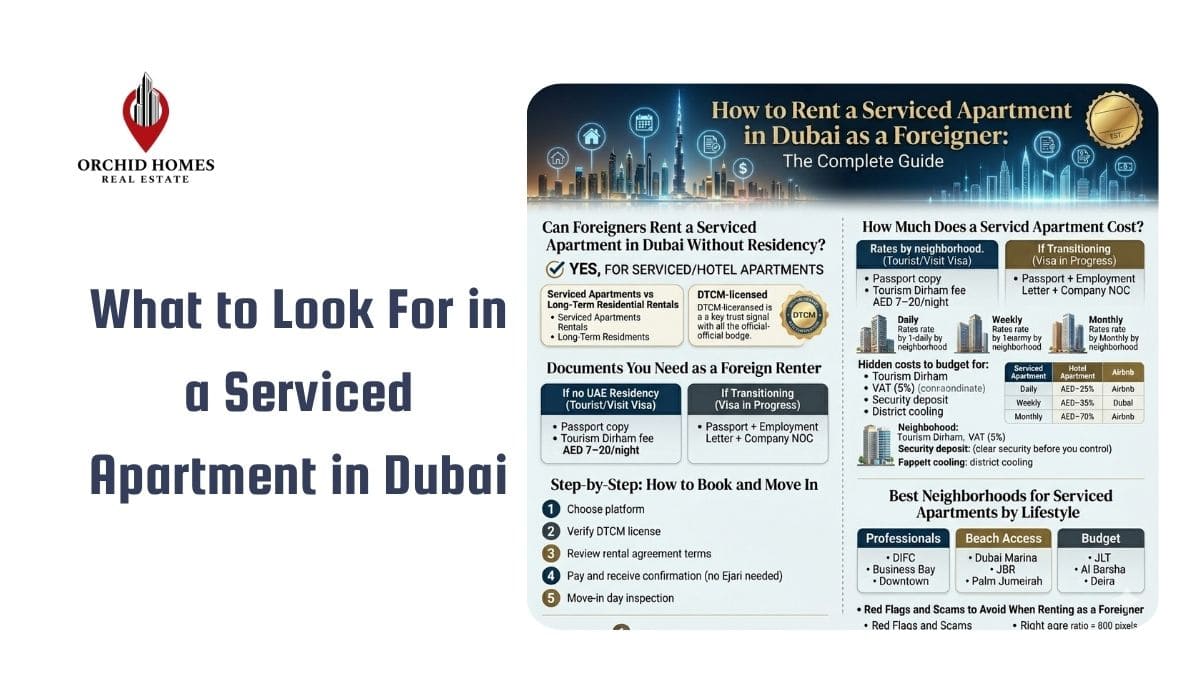
Foreigners can rent a serviced apartment in Dubai legally and without a UAE residency visa or Emirates ID. Serviced apartments operate under a separate licensing system from standard residential leases, which means the process is simpler, the paperwork is minimal, and in most cases, a valid passport is all you need to move in.
Can Foreigners Rent a Serviced Apartment in Dubai Without Residency?
Yes, and this is one of the most misunderstood aspects of Dubai’s rental market. Many first-time arrivals assume that the strict documentation rules they read about, such as Emirates ID, Ejariregistration, and post-dated cheques, apply to every rental in the city. Well, this is not true. Those requirements apply specifically to standard long-term residential leases signed for 12 months or more.
Serviced apartments and hotel apartments in Dubai sit in a different legal category entirely. They are regulated under Dubai’s hospitality framework rather than the residential tenancy framework. This means non-residents can book them freely, stay for days, weeks, or months, and face none of the documentation barriers that block access to conventional housing.
This distinction matters enormously if you are arriving in Dubai for the first time, transitioning between visas, or working on a short assignment. Renting in Dubai without residency is genuinely possible, but only through the serviced apartment and hotel apartment route.
The Difference Between Serviced Apartments and Long-Term Residential Rentals
A standard residential lease in Dubai requires the tenant to hold a valid UAE residency visa and Emirates ID. These are needed to register the tenancy contract through the Ejari system, which is the government platform run by the Dubai Land Department. Without Ejari registration, tenants cannot activate utilities through DEWA (Dubai Electricity and Water Authority) and have no legal protection in the event of a dispute.
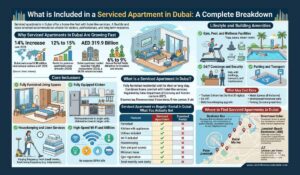
Serviced apartments bypass all of this. They come fully furnished, include utilities in the monthly rate, and are managed like hotel properties. The operator handles all regulatory obligations. The tenant simply checks in, lives comfortably, and checks out when their stay ends. There is no Ejari registration required and no DEWA setup needed.
This makes serviced apartments not just a convenient option for foreigners but often the only legal option available until their residency documentation is in place.
What “DTCM-Licensed” Means and Why It Protects You
Every legitimate short-term rental in Dubai must hold a license from DTCM, the Dubai Department of Economy and Tourism. A DTCM-licensed short-term rental Dubai property has met the city’s safety, hospitality, and operational standards and is accountable to a government regulatory body.
For renters, the DTCM license is the single most important thing to verify before paying anything. A licensed property means your booking is legally protected and the operator is held to defined quality benchmarks. An unlicensed property offers no legal recourse if something goes wrong.
You can verify a DTCM license number directly on the Dubai Tourism portal. Any reputable operator will display their license number on their website or listing. If they cannot provide it, walk away.
Documents You Need as a Foreign Renter
Understanding what Dubai apartment rental documents are required is the first practical step every foreign renter needs to take. The good news is that for serviced apartments, the list is far shorter than most people expect, and it varies depending on your current visa situation.
1. If You Have No UAE Residency Yet (Tourist or Visit Visa)
If you are entering Dubai on a tourist visa, a visit visa, or even a visa on arrival, a valid passport is typically the only document required to book and check into a serviced apartment. Some operators may also ask for a copy of your entry stamp or visit visa, a credit card to hold against incidentals, or a printout of your return flight. Beyond that, the process is as straightforward as booking a hotel room.
You will also be subject to the Dubai Tourism Dirham, a nightly fee of AED 7 to AED 20 depending on the star rating or classification of the property. This fee is charged in addition to the advertised rate and applies automatically to all non-resident guests staying in licensed hospitality properties.
2. If You Are Transitioning to Residency (Visa in Progress)
This is the bridge period scenario that most rental guides ignore entirely, yet it is one of the most stressful situations a new arrival faces. You have accepted a job in Dubai, your employer is processing your residency visa, and you need somewhere legal to live for the next three to eight weeks before your Emirates ID arrives.
Serviced apartments are the correct answer for this period. In addition to your passport, some operators serving corporate or relocation clients may ask for an employment offer letter or a company NOC (No Objection Certificate) if your employer is handling the booking. For direct individual bookings, your passport remains sufficient.
Once your Emirates ID and residency visa arrive, you gain access to the full residential rental market and can negotiate a standard long-term lease with significantly lower monthly rates.
How Much Does a Serviced Apartment in Dubai Actually Cost?
Understanding the real cost of a serviced apartment Dubai monthly rent requires looking beyond the advertised nightly or monthly figure. The headline price rarely reflects what you will actually pay once all fees and inclusions are considered. This section breaks down the true numbers so you can budget accurately before you arrive.
1. Daily, Weekly, and Monthly Rate Breakdown by Neighborhood
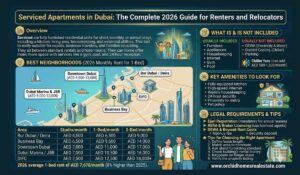
Current market data shows that average daily rates for serviced apartments in Dubai sit at approximately AED 870, with weekly rates near AED 6,100. For those committing to a full month, average monthly rents run around AED 20,000, though this varies substantially by area.
Here is a realistic breakdown by neighborhood for a one-bedroom serviced apartment:
| Neighborhood | Monthly Rate (AED) | Best For |
| Downtown Dubai / Business Bay | 25,000 to 40,000 | Corporate professionals, DIFC commuters |
| Dubai Marina / JBR | 20,000 to 35,000 | Lifestyle-focused expats, beach access |
| Palm Jumeirah | 35,000 to 60,000+ | Premium stays, resort-style amenities |
| Jumeirah Lake Towers (JLT) | 12,000 to 22,000 | Remote workers, budget-conscious expats |
| Al Barsha / Tecom | 10,000 to 18,000 | Mid-range, good metro access |
| Deira / Bur Dubai | 8,000 to 15,000 | Budget stays, cultural richness |
Annual rates for those committing to longer stays show a similar spread. Studio apartments range from approximately AED 60,000 to AED 185,000 per year, while one-bedroom units run from AED 90,000 to AED 400,000 depending on building quality and location.
Note: These are average rates taken from different property listing websites in Dubai and other Emirates. Please do your own research as well.
2. Hidden Costs to Budget For
The sticker price of a Dubai furnished apartment that short-term foreign renters see advertised is rarely the final number. Before you commit to any booking, factor in the following additional costs carefully.
- The Tourism Dirham runs AED 7 to AED 20 per night and is charged automatically on all non-resident stays in licensed hospitality properties. On a 30-night stay, this adds AED 210 to AED 600 on top of your rent.
- VAT of 5% applies to short-term serviced apartment rentals. Long-term residential leases of 12 months or more are exempt, but if you are renting month-to-month as a non-resident, expect this cost to apply.
- Security deposits typically equal one to two months’ rent or a fixed amount, depending on the property. For furnished units under longer arrangements, deposits of 10% of the annual rent are common. Confirm the refund terms before signing anything.
- District cooling fees apply in many premium buildings and are billed separately from the base rent. These can add AED 500 to AED 2,000 per month, depending on usage and building size. Always ask the operator whether district cooling is included or charged on top.
Early exit penalties can cost the equivalent of one month’s rent if you leave before the agreed period ends. Read the exit clause carefully before committing to any term longer than one month.
3. Hotel Apartment vs Serviced Apartment Dubai: Which One Do You Actually Need?
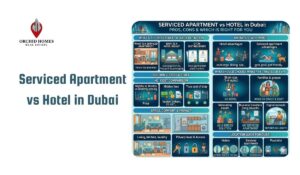
The hotel apartment vs serviced apartment Dubai question is one that confuses a lot of incoming renters, and the distinction matters both for your budget and your expectations. Here is a clear side-by-side breakdown:
| Factor | Serviced Apartment | Hotel Apartment | Airbnb / Short-Term Rental |
| Legal for non-residents | Yes | Yes | Yes, if DTCM-licensed |
| Documents required | Passport only | Passport only | Passport only |
| Minimum stay | Typically 1 month | Daily to monthly | Daily |
| Utilities included | Yes | Yes | Usually yes |
| Housekeeping | Weekly or bi-weekly | Daily or on request | Varies |
| Kitchen facilities | Full kitchen | Kitchenette or full | Usually full |
| Hotel-style services | Limited | Concierge, room service | None |
| Relative cost | Mid to high | High | Low to mid |
| Best for | Stays of 2 weeks to 12 months | Short business trips | Flexible budget travel |
A hotel apartment is the right choice when you need daily housekeeping, round-the-clock concierge, and the flexibility to check out on short notice. A serviced apartment for expats in Dubai makes more sense when you are settling in for several weeks or months and want a more residential feel with a full kitchen and more living space for the money.
Step-by-Step: How to Book and Move into a Serviced Apartment in Dubai
The process of learning how to rent a serviced apartment in Dubai as a foreigner is more straightforward than most people expect, provided you follow the right steps and know what to verify at each stage.
Step 1: Choose Your Platform
The four main channels for finding a serviced apartment Dubai for expats and non-residents are property portals, direct operators, and short-term rental platforms.
PropertyFinder and Bayut are the two dominant property portals in the UAE. Both have dedicated sections for hotel apartments and furnished short-term rentals, with filters for monthly pricing, location, and included amenities.
Dubizzle carries a broader mix of listings, including private landlords, and is worth checking for value options, though you should exercise more caution with unverified private listings. You can also visit the properties section on Orchid Homes Real Estate to find serviced apartments and other types of properties.
Direct operators such as Blueground, DAMAC Maison, Marriott Executive Apartments, and other branded serviced apartment companies offer bookings directly through their own websites. Booking directly often gets you better rates and clearer contract terms than going through a third-party agent.
Airbnb is legal for short-term bookings in Dubai, provided the listing holds a valid DTCM license. It works well for stays under a month, but it becomes expensive compared to negotiated monthly rates for longer periods.
Step 2: Verify the DTCM License Number
This is the step that almost no other guide mentions, and it is the most important one for protecting yourself as a foreign renter. Before paying any deposit or signing anything, locate the DTCM license number in the listing or ask the operator directly.
A legitimate property will have this number displayed on its website, booking portal, or contract documentation. You can cross-reference it on the Dubai Tourism portal to confirm the license is active and matches the property address. If an operator cannot provide a license number, do not proceed with that booking.
Step 3: Review the Rental Agreement Terms
Once you have selected a property and confirmed its DTCM license, review the rental agreement carefully. Pay close attention to what is included in the monthly rate, including utilities, Wi-Fi, housekeeping, parking, and gym access. Check the early exit terms and the penalty for leaving before the agreed period.
Understand how much notice is required to renew or terminate. Confirm the security deposit amount and the conditions under which deductions can be made.
Do not assume that anything is included unless it is written into the agreement. Verbal assurances from agents are not enforceable.
Step 4: Pay and Receive Your Confirmation
Serviced apartments in Dubai generally accept payment by bank transfer, credit card, or cheque. Unlike standard residential leases, where post-dated cheques covering 3, 6, or 12 months of rent upfront are the norm, serviced apartment operators typically bill monthly. This is one of the key financial advantages for non-residents who do not yet have a UAE bank account.
Confirm your booking in writing and ensure you receive a signed agreement, a receipt for any deposit paid, and the operator’s contact details for maintenance or service requests.
Step 5: Move-In Day — What to Inspect and Document
On the day you collect your keys, conduct a thorough inspection of the apartment before settling in. Photograph everything that is already damaged or worn and send these photos to the operator in writing on day one, timestamped. This protects your security deposit at checkout.
Confirm that Wi-Fi is active, utilities are running, and that you have been given access to all amenities written into your agreement. If anything is missing or not functioning, raise it in writing immediately.
Best Areas for Expats to Rent Dubai 2025: Matched to Your Lifestyle
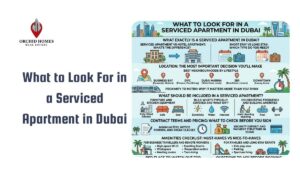
Rather than a generic list of neighborhoods, what helps you make the right decision is matching the area to your specific situation. Here is how to think about the best areas for expats to rent Dubai 2025 based on why you are here and how you plan to live.
1. For Professionals and Corporate Stays: DIFC, Business Bay, Downtown Dubai
If you are in Dubai for work, particularly in finance, consulting, law, or technology, the DIFC and Business Bay corridor is the most practical base.
Business Bay sits directly adjacent to DIFC and Downtown Dubai, putting you within walking distance of major employers, the metro, and Dubai Mall.
Properties like SLS Dubai Hotel and Residences and DAMAC Maison offer fully furnished one-bedroom units with Burj Khalifa views and rooftop facilities.
Expect monthly rates between AED 25,000 and AED 40,000 for a well-located one-bedroom in this zone.
2. For Beach Access and Lifestyle: Dubai Marina, JBR, Palm Jumeirah
Dubai Marina and Jumeirah Beach Residence are the go-to areas for expats who want an active social life alongside their accommodation.
The Walk at JBR puts dozens of restaurants, cafes, and retail options directly below your apartment. Annual rents for one-bedroom serviced units in this zone typically range from AED 120,000 to AED 200,000, depending on views and building amenities.
Palm Jumeirah represents the premium end of this category, with private beach access, spa facilities, and a quieter resort-like atmosphere. Two-bedroom units on the Palm generally start from AED 300,000 annually.
3. For Budget-Conscious Long Stays: JLT, Al Barsha, Deira
Jumeirah Lake Towers (JLT) is arguably the best value proposition in Dubai for remote workers and digital nomads. It has excellent metro access via the DMCC station, a genuine community feel, and monthly rates that come in significantly below Marina pricing.
Al Barsha offers similar value with proximity to the Mall of the Emirates. Deira and Bur Dubai provide the most affordable options in the city with a culturally rich environment that many long-stay expats appreciate.
Red Flags and Scams to Avoid When Renting as a Foreigner
Dubai’s rental market moves fast, and foreign renters without a local network are particularly exposed to certain risks. Being aware of the following warning signs will protect your money and your stay.
1. Ghost Listings and Fake Availability
Ghost listings are common on real estate platforms. Some properties advertised do not exist or are not available on the dates shown. The listing exists solely to generate agent inquiries. If an agent cannot arrange a viewing within a few days, question whether the property is real.
2. Unlicensed Real Estate Agents (RERA Compliance)
Agents unlicensed by RERA are another serious risk. All real estate agents operating in Dubai must be registered with RERA, the Real Estate Regulatory Agency. Verify any agent’s registration number on the Dubai Land Department website before signing anything or paying any fee.
3. Cash-Only Payment Scams
Cash-only operators should be avoided entirely. Legitimate serviced apartment operators in Dubai accept card payments and provide written contracts. Any operator insisting on cash with no formal receipt is operating outside the boundaries of what Dubai’s regulations permit.
4. High-Pressure Sales Tactics
Pressure to commit without viewing is a classic scam technique. High-pressure tactics urging you to pay immediately to secure a unit before someone else takes it are a reliable warning sign. A legitimate operator will allow you adequate time to review the agreement and, where possible, visit the property.
5. Unlicensed Airbnb and Short-Term Rentals
Unlicensed Airbnb properties are a real risk in Dubai. Not every listing on short-term platforms is DTCM-licensed. Staying in an unlicensed property is technically illegal in Dubai and leaves you with no formal recourse in the event of a dispute. Always ask for the DTCM permit number before confirming any short-term booking.
Ejari Registration Dubai: What Expats Need to Know
The Ejari registration Dubai system is one of the most searched topics among incoming expats, and understanding when it applies to you and when it does not is essential.
Ejari is the Dubai Land Department’s online platform for registering residential tenancy contracts. It is mandatory for all standard long-term residential leases. Without Ejari, tenants cannot activate DEWA utilities, renew their residency visa, or seek formal legal protection in a tenancy dispute.
However, Ejari registration does not apply to serviced apartments, hotel apartments, or DTCM-licensed short-term rentals. If you are renting a serviced apartment as a non-resident, you will never interact with the Ejari system during that stay. Ejari only becomes relevant once you transition to a standard residential lease after obtaining your residency visa and Emirates ID.
When that time comes, the Ejari registration process costs approximately AED 220 to AED 300, depending on whether you handle it yourself or through an agent, and it must be completed before DEWA can be activated at your new address.
Frequently Asked Questions
Can a foreigner rent a serviced apartment in Dubai without a residency visa?
Yes. Serviced apartments and hotel apartments in Dubai do not require an Emirates ID or UAE residency visa. A valid passport is sufficient for check-in. This is the primary legal housing route available to non-residents, tourists, and expats who are still in the process of obtaining their residency documentation.
What documents do I need to rent a serviced apartment in Dubai as a non-resident?
A valid passport is typically the only document required. Some operators may also request a copy of your visit visa, a credit card for incidentals, or an employment offer letter for corporate bookings. No Ejari registration, post-dated cheques, or Emirates ID are needed for serviced apartment rentals.
How much does a serviced apartment in Dubai cost per month?
Monthly rates range from approximately AED 8,000 to AED 15,000 for a studio in Deira or Al Barsha, AED 20,000 to AED 35,000 for a one-bedroom in Dubai Marina or Business Bay, and AED 35,000 to AED 60,000 or more for premium units on Palm Jumeirah. Rates include utilities and housekeeping but exclude the Tourism Dirham and VAT.
What is the difference between a hotel apartment and a serviced apartment in Dubai?
A serviced apartment is a fully furnished residential unit available on flexible terms from one month upward, with a more residential feel and typically a full kitchen. A hotel apartment operates within a licensed hotel or aparthotel, offers more daily services like room service and concierge, and is available for shorter stays. Both are legally accessible to non-residents with a passport only.
Is it safe to rent a serviced apartment in Dubai as a foreigner?
Yes, provided you verify the property holds a valid DTCM license before booking. Book through platforms like PropertyFinder or Bayut, or directly with recognized operators. Avoid any listing that cannot provide a DTCM license number, demands cash-only payment, or refuses to issue a written agreement.
Do I pay VAT on a serviced apartment in Dubai?
Yes. Short-term serviced apartment rentals are subject to 5% VAT in Dubai. You will also pay the Dubai Tourism Dirham, a nightly fee of AED 7 to AED 20 depending on the property’s classification. Long-term residential leases of 12 months or more are exempt from VAT.
Can I use Airbnb to rent an apartment in Dubai as a foreigner?
Yes, but only if the property holds a valid DTCM license. Unlicensed short-term rentals are illegal in Dubai. Always ask the host for their DTCM permit number before confirming a booking. Licensed Airbnb properties are a legitimate and flexible option, particularly for stays under one month.
How long can a foreigner stay in a serviced apartment in Dubai?
There is no legal maximum on the duration of your stay in a serviced apartment, as long as your entry visa remains valid. Most tourist visas allow 30 to 90 days and can be renewed. For stays beyond 90 days, transitioning to a UAE residency visa opens access to better long-term rental rates across the standard residential market.